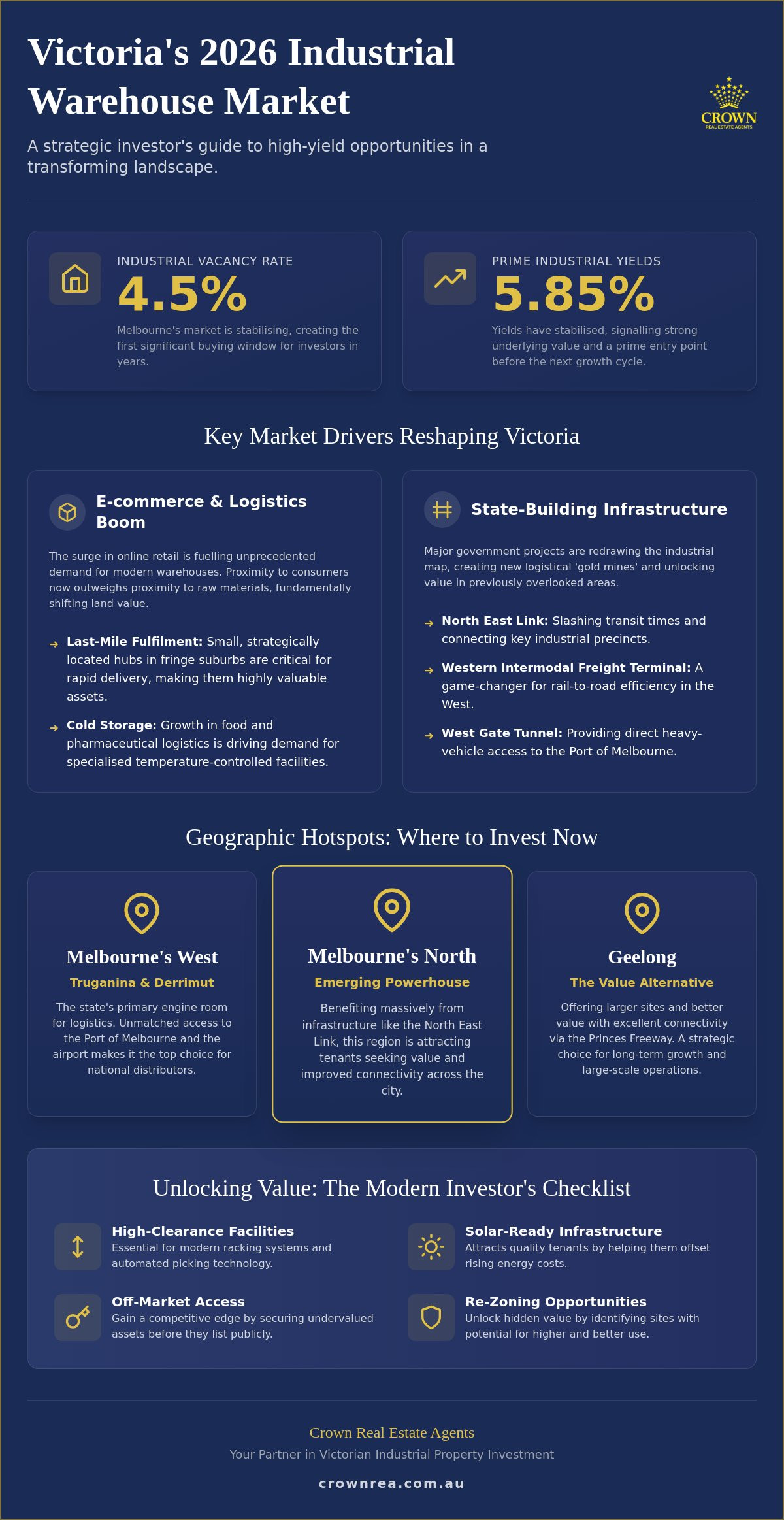
With Melbourne’s industrial vacancy rate climbing to 4.5 percent in early 2026, many investors assume the market is cooling, yet this shift actually creates the first real window for buyers in years. When you are searching for a warehouse for sale Victoria, you’ll notice that the landscape is changing faster than the listing aggregators can keep up. You’ve likely felt the frustration of high entry costs in established zones or the headache of navigating complex Victorian zoning laws just to secure a viable site. It’s a common challenge, but the current stabilisation of prime yields at 5.85 percent suggests that strategic opportunities are still very much on the table.
We’ll show you exactly how to cut through the noise to find high-yield warehouse opportunities and identify the next “hot” industrial precincts before the competition catches on. You’ll learn how to add tangible value to your assets and understand the shifts in tenant demand across the West and North. We’ll also preview how our team secures off-market access to shovel-ready sites, giving you a clear pathway to grow your property portfolio with confidence and local expertise.
Key Takeaways
- Learn how the 2026 shift toward e-commerce fulfilment is redefining the search for a warehouse for sale Victoria, making last-mile locations more valuable than ever.
- Identify the specific high-growth industrial corridors in Melbourne’s West and North that are outperforming the market this year.
- Discover how to unlock hidden value in industrial assets by identifying shovel-ready sites and leveraging re-zoning opportunities.
- Understand the critical technical specifications, such as floor loading and solar-ready infrastructure, that attract high-quality tenants and command premium rents.
- Gain a competitive edge by accessing off-market deals to secure undervalued industrial gems before they hit the general market.
Table of Contents
- The 2026 Victorian Industrial Landscape: Why Warehouses are the New Gold
- Geographic Hotspots: Where to Find a Warehouse for Sale in Victoria
- Warehouses as Strategic Development Sites: Beyond the Four Walls
- Key Considerations for Industrial Investors in Victoria
- Securing the Best Deal: The Crown Real Estate Advantage
The 2026 Victorian Industrial Landscape: Why Warehouses are the New Gold
Victoria’s industrial sector is undergoing its most significant transformation in decades. The old-school manufacturing plants that once dominated the skyline are rapidly making way for high-tech e-commerce fulfilment centres. This isn’t just a change in tenant type; it’s a fundamental shift in how land is valued. In 2026, proximity to consumers now outweighs proximity to raw materials. If you’re looking for a warehouse for sale Victoria, you’ll find that the market correction over the last twelve months has created a rare entry point. Prices have stabilised after the post-pandemic surge, allowing savvy investors to secure assets with strong long-term fundamentals before the next growth cycle begins.
E-commerce and the Logistics Boom
The rise of online shopping has turned warehouses into the engine room of the retail economy. Tenants now prioritise high-clearance facilities that allow for sophisticated racking systems and automated picking technology. This demand is particularly high near major arterial roads like the M1 and M80. Many local businesses are now hunting for a warehouse for sale Victoria that offers both high clearance and solar-ready infrastructure to offset rising energy costs. Last-mile logistics refers to the final leg of a product’s journey from a distribution centre to the customer’s doorstep, a process that relies on small, strategically placed hubs within Melbourne’s fringe suburbs to ensure rapid delivery. Cold storage is another niche seeing explosive growth in 2026, driven by a greater focus on food security and pharmaceutical logistics.
Infrastructure Projects Driving Warehouse Value
Major Victorian government investments are redrawing the industrial map. Projects currently under construction or reaching completion are creating new “gold mines” for property development. Consider these key drivers:
- The North East Link: This project is slashing transit times between the northern suburbs and the south-east, making previously overlooked pockets incredibly attractive for logistics firms.
- Western Intermodal Freight Terminal: A game-changer for the West, this terminal will enhance rail-to-road efficiency and drive up land values in surrounding precincts.
- West Gate Tunnel: This is revitalising industrial pockets in Yarraville and Footscray by providing direct, heavy-vehicle access to the Port of Melbourne.
For those priced out of Melbourne’s inner ring, Geelong has emerged as a viable alternative. It offers larger allotments and better value while maintaining excellent connectivity via the Princes Freeway. Large institutional players and Australian real estate investment trusts (A-REITs) are already consolidating land near the Port of Melbourne expansion, signalling a long-term commitment to these high-traffic zones. Securing a site in these infrastructure-rich areas is no longer just about storage; it’s a strategic play on the state’s logistical future.
Geographic Hotspots: Where to Find a Warehouse for Sale in Victoria
Location remains the single most important factor in industrial property performance. While the broader market is stabilising, specific Victorian precincts are outperforming others due to targeted infrastructure investment and shifting tenant requirements. Identifying the right suburb isn’t just about finding a building; it’s about securing a spot in a high-demand logistics chain. Whether you’re an owner-occupier or an investor, understanding the micro-movements in these hotspots is essential for long-term capital growth.
The Western Suburbs: Truganina and Beyond
Melbourne’s West continues to be the primary engine room for Victorian industrial activity. Suburbs like Truganina and Derrimut have solidified their status as national logistics hubs. According to the JLL Q1 2026 Industrial Market Analysis, the West currently holds the highest vacancy rate in Melbourne at 4.8 percent. While this might sound high, it’s actually creating much-needed breathing room for businesses that were previously squeezed out by record-low supply. National giants continue to favour this corridor for its unmatched access to the Port of Melbourne and the airport. If you’re tracking these shifts, our Melbourne Property Market Forecast 2026 provides a deeper dive into how these supply levels are expected to balance out over the coming year.
The North and South East Corridors
The Northern corridor is undergoing a massive transition. Mickleham, specifically the Merrifield Business Park, has become a benchmark for master-planned industrial success. It’s no longer just about basic storage; this area is attracting high-tech manufacturing and automated distribution centres. In contrast, the South East remains the tightest market in Victoria with a vacancy rate of just 3.7 percent. Suburbs like Pakenham and Cranbourne are booming as they service the massive residential growth in the region. For investors, the North often offers slightly higher yields, while the South East provides strong security through lower vacancy and high owner-occupier demand. You can explore our current warehouse sales to see how entry prices compare across these two distinct markets.
Regional Victoria’s Rising Stars
The search for a warehouse for sale Victoria is increasingly leading buyers beyond the metropolitan fringe. Ballarat and Bendigo are no longer just regional service towns; they are becoming strategic distribution points. Improved rail freight links and lower land costs are driving a wave of “de-centralisation” for businesses that don’t require daily CBD access. These regional hubs offer a unique opportunity to secure larger allotments that are simply unavailable or unaffordable in Melbourne’s core industrial zones. We’re seeing a rise in large-scale distribution centres setting up shop here to service both the Melbourne and regional markets efficiently.
Warehouses as Strategic Development Sites: Beyond the Four Walls
A warehouse for sale Victoria is frequently viewed as a simple storage solution, but savvy investors look past the existing concrete and steel. They see a strategic land bank. Aging industrial assets often occupy large allotments in precincts that have evolved around them, making the land itself far more valuable than the structure it supports. As outlined in Victoria’s 10-year plan for industrial land, the demand for modern, efficient space is outpacing the supply of vacant land in established zones. This gap creates a massive opportunity for those willing to redevelop or re-purpose existing sites to meet 2026 standards.
Unlocking Value Through Joint Ventures
Owners of older warehouses often face a dilemma: the building needs significant upgrades to attract top-tier tenants, but the capital required is substantial. This is where joint ventures become a powerful tool. Our “your land our build” model allows landholders to partner with us to unlock the full potential of their site without taking on traditional bank debt. You provide the land, and we provide the expertise and construction capital to deliver a modern facility. We facilitate these unique partnerships by matching landholders with the right development resources to ensure a profit-sharing outcome that benefits all parties. It’s a low-risk way to turn a stagnant asset into a high-performing logistics hub with a debt-free profit share.
Shovel-Ready Industrial Sites
In the Victorian planning system, “shovel-ready” is a term that commands a significant premium. A shovel-ready site is one where the heavy lifting of bureaucratic approvals has already been done. This includes having a valid planning permit, completed environmental audits, and confirmed service connections. Buyers are increasingly happy to pay more for these sites because they eliminate the twelve to eighteen month delay typically associated with council approvals. If you are looking for the latest opportunities in this space, follow Crown Real Estate on Instagram for our latest site acquisitions and development updates.
The re-zoning potential of Victorian land is another critical value driver. Moving a site from Industrial 1 (IN1Z) to Mixed-Use or even Residential can lead to an overnight surge in capital value. While the state government’s long-term plan focuses on preserving industrial land for jobs, certain pockets near residential growth corridors in the South East are prime candidates for re-classification. Identifying these sites before the formal re-zoning process begins is how the most successful Victorian investors build their wealth. It requires a deep understanding of local council strategies and a proactive approach to site acquisition.
Key Considerations for Industrial Investors in Victoria
When you’re evaluating a warehouse for sale Victoria, the building’s physical dimensions are just as important as its postcode. Modern logistics tenants in 2026 are no longer satisfied with basic four-wall structures. They require specific technical capabilities to run their operations efficiently. Internal clearance heights are now a primary value driver; e-commerce fulfilment centres typically seek heights of 10 metres or more to accommodate advanced racking systems. Similarly, floor loading capacity must be verified. High-volume warehouses need reinforced slabs capable of supporting heavy automated machinery and constant forklift traffic without cracking or shifting.
Financial structures in Victorian commercial real estate also require careful navigation. Most warehouse transactions attract GST, though you might be able to purchase a property as a “Going Concern” to avoid the upfront tax if the site has an active lease. Stamp duty remains a significant cost in Victoria, so it’s vital to factor this into your initial capital requirements. You’ll also need to decide between a strata-titled unit and a freestanding facility. Strata units offer a lower entry point and shared maintenance costs, making them ideal for smaller portfolios. Freestanding assets provide greater control and long-term redevelopment potential, which often leads to superior capital growth.
Zoning and Permitted Uses
Victorian zoning laws determine what a tenant can actually do on your site. Industrial 1 (IN1Z) is the most flexible, allowing for a wide range of manufacturing and distribution activities. Industrial 3 (IN3Z) is more restrictive and is often used as a buffer zone near residential areas. A significant value-add opportunity lies in securing a “restricted retail” permit. This allows for showroom-style businesses, which typically pay higher rents than traditional industrial tenants. You should also check for environmental overlays or heritage listings on older Victorian factories. These can impose strict limits on renovations and significantly increase the cost of any future upgrades.
Modern Warehouse Tech and Sustainability
Sustainability has moved from a “nice-to-have” to a financial necessity. In 2026, solar-ready warehouses are commanding rent premiums of up to 10 percent because they help tenants manage soaring energy costs. The introduction of NABERS for Industrial ratings has also changed how properties are valued; a high green rating now translates directly into better financing terms and higher resale value. Connectivity is the final piece of the puzzle. Modern tenants rely on high-speed fibre and 5G to run Automated Storage and Retrieval Systems (ASRS). If a site lacks this infrastructure, it risks becoming obsolete in a tech-driven market. If you’re unsure how your current asset stacks up against these modern requirements, we can provide a professional market appraisal to help you identify high-value upgrade opportunities.
Securing the Best Deal: The Crown Real Estate Advantage
Success in the Victorian industrial market often comes down to who you know and how quickly you can act. While public aggregators are useful for general research, the most lucrative transactions for a warehouse for sale Victoria frequently occur before a property ever reaches the open market. We specialise in these off-market opportunities, providing our clients with a distinct advantage in a highly competitive landscape. By the time a listing appears on a national portal, the most aggressive investors have already moved. Working with us means you get the first look at shovel-ready sites and high-yield assets that others simply won’t see.
Off-Market Access and Quick Sales
Our extensive network across Truganina, Mickleham, and the South East connects motivated vendors with serious buyers for a quick sale. For many industrial business owners, a discreet transaction is preferred to avoid disrupting daily operations or alerting competitors to their business moves. We facilitate these private sales with total transparency and professional management. If you’re considering listing a property or want to know its current value, use code 2026 when you contact us. This code secures a priority market appraisal for your industrial asset, ensuring you have the most accurate data before making your next move. We also offer a $3000 referral incentive for successful property introductions, making it even more rewarding to partner with our team.
Growing Your Portfolio with Crown
Transitioning from residential real estate into the commercial sector is a proven strategy to grow your property portfolio with us. Industrial assets typically offer longer lease terms and higher yields than residential holdings, providing a stable foundation for long-term wealth. We take our professional responsibilities seriously, acting as your knowledgeable local partner throughout every stage of the acquisition. Our team, led by Inder Sandhu, brings deep local knowledge to the table. Inder’s roots in the Victorian industrial landscape mean he understands the micro-movements of specific precincts. He knows which streets are seeing the most tenant interest and which pockets are about to benefit from the next infrastructure milestone. This level of insight is what allows us to find undervalued gems that others overlook.
Securing a high-value industrial asset in 2026 requires more than just a search bar; it requires a proactive strategy and a partner who understands the nuances of the Victorian market. We don’t just find buildings; we identify strategic logistics hubs that are future-proofed against shifting trends. Our commitment to clear communication and transactional efficiency ensures you can move from inquiry to settlement without unnecessary delays. Contact Inder Sandhu today to discuss your industrial property goals and discover how we can help you secure your next high-performing warehouse for sale Victoria.
Maximise Your Industrial Investment Potential in 2026
The Victorian industrial landscape is shifting toward high-tech logistics and e-commerce fulfilment, making strategic site selection more critical than ever. We’ve explored how technical specifications and infrastructure projects like the North East Link are driving capital growth in key hotspots. Finding a high-performing warehouse for sale Victoria requires a proactive approach that looks beyond standard listings to identify hidden development potential and re-zoning opportunities. You need to understand the micro-movements of the market to secure assets that command premium rents.
You don’t have to navigate these complexities alone. As specialists in off-market industrial deals and experts in Victorian zoning, we provide the local knowledge you need to outpace the competition. You’ll gain direct access to Inder Sandhu’s expertise to ensure your next acquisition is a high-yield success. Book a Free Warehouse Market Appraisal with Crown Real Estate today to get a clear picture of your asset’s value. We’re ready to help you grow your property portfolio with confidence and transparency. Book your appraisal now and take the first step toward your next strategic industrial move.
Frequently Asked Questions
What is the average yield for a warehouse for sale in Victoria in 2026?
Prime industrial yields in Melbourne averaged 5.85 percent as of March 2026, providing a stable return for investors in a consolidating market. Secondary industrial assets offered slightly higher yields, averaging 6.75 percent during the same period. These figures reflect the current flight to quality, where premium assets with modern technical specs command lower yields due to their high tenant demand and lower risk profile.
Do I need to pay GST when buying a warehouse in Victoria?
You generally pay GST on commercial property transactions unless the sale qualifies as a “Going Concern”. To meet this requirement, the warehouse must be sold with an active lease in place, and the enterprise must continue until the day of supply. This exemption is a major financial incentive that can save you significant upfront capital when you grow your property portfolio with us.
What is the difference between Industrial 1 and Industrial 2 zoning?
Industrial 1 (IN1Z) is the most flexible zone, designed for a broad range of manufacturing and distribution activities that have minimal impact on surrounding areas. Industrial 2 (IN2Z) is specifically for heavier industries that may have more significant off-site effects, such as noise or emissions. Understanding these Victorian zoning laws is vital to ensure your intended business use is permitted on the site.
Can I convert a warehouse into a residential property in Melbourne?
You can convert a warehouse into a residential dwelling, but it requires a successful re-zoning application through the local council. The land typically needs to be re-classified to a Mixed-Use or Residential zone, which involves rigorous environmental audits to ensure the site is safe for habitation. This strategy can lead to a massive surge in capital value for older assets in gentrifying inner-city pockets.
What are the benefits of buying a warehouse off-market?
Buying off-market allows you to secure a warehouse for sale Victoria before it hits public aggregators and attracts intense competition. This discreet approach often results in a more collaborative transaction and allows you to find undervalued gems that aren’t visible to the general public. Our network provides direct access to these private listings, helping you beat the aggregator rush and secure better terms.
How much deposit is typically required for a commercial warehouse purchase in Australia?
Most commercial lenders require a deposit between 30 and 35 percent of the total purchase price. This is significantly higher than the 10 or 20 percent usually seen in residential real estate because commercial assets carry different risk profiles. While some lenders offer lower deposit options for owner-occupiers with strong business financials, you should prepare for a larger upfront capital commitment to secure the best interest rates.
What should I look for during a warehouse building inspection?
You should prioritise technical specifications like internal clearance heights, floor loading capacity, and truck turning circles. It’s also essential to check for hazardous materials such as asbestos in older Victorian factories and verify that the electrical supply can support modern automated machinery. A professional inspection identifies these potential deal-breakers early, ensuring your asset remains attractive to high-quality logistics tenants.
Is Geelong a good place to buy industrial property compared to Melbourne?
Geelong is a highly viable alternative to Melbourne, offering larger land allotments and lower entry costs for investors and owner-occupiers. With excellent connectivity via the Princes Freeway and the local port, it has become a strategic hub for large-scale distribution centres. Many businesses are moving to Geelong to escape the high density and rising rents of Melbourne’s inner-western and northern industrial corridors.
Disclaimer
Disclaimer: Crown Real Estate Agents has taken all care in preparing this information. However, all details are sourced from third parties and may change. You are encouraged to conduct your own due diligence.